8 minutes
16 rounds into GG no re
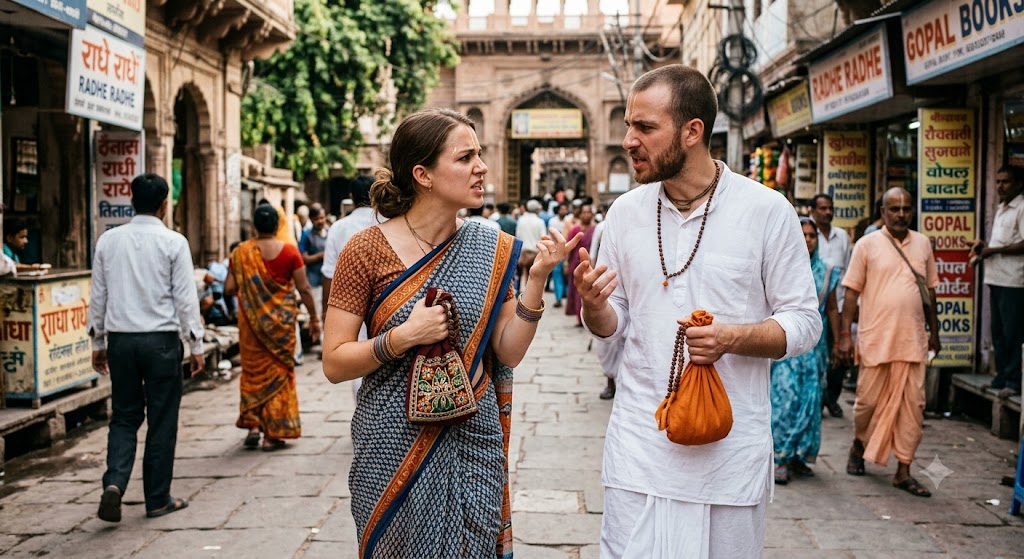
Just last year I wrote the following exam question when I was teaching a group of young devotees the first six chapters of the Bhagavad-gītā:
Michael and Gretchen got married in 2001 after 2 years of getting to know each other. Michael comes from a brahmacārī background, a stickler for rules. Gretchen, although from a Vaiṣṇava family, has grown up with a lot of freedom. She loves exploring the world and is quite emotionally intelligent.
After their marriage, they start experiencing significant relationship issues. Michael complains that the marriage is sidetracking him from the main purpose of life - Kṛṣṇa Consciousness. He says that he’s made a huge mistake in choosing his wife, because all she wants to do is enjoy her senses. She wants to travel the world, experience breakfast in bed, and even go on cruises! So much for being a devotee. Furthermore, he has to spend such a huge amount of time just doing useless things like window-shopping with her. Although he loves his job, he feels he is wasting time spending 8 hours staring at a screen rather than doing Kṛṣṇa conscious things.
Gretchen says that marriage, in her opinion, is about exploring the world in a safe space. Why does everything have to fit into neat categories of “sense enjoyment” vs “bhakti”? She argues that a real devotee sees Kṛṣṇa in every experience, not just at the temple. However, she finds it impossible to argue with Michael, because he seems to be operating on completely different assumptions. Also, because he knows more ślokas and feels he’s better at logic, he doesn’t seem to consider her philosophical opinion valid. She knows that his practice of KC, if it were so pure, wouldn’t have required him to seek out his own freedom and free time so much, especially in doing services that he wants to do, rather than follow what his “authorities” have told him to do.
Over time, the couple separates. Michael feels trapped in the relationship with his overly materialistic wife. However, after their divorce, he completely stops practising bhakti. He finds it difficult to control his mind, with surges of enthusiasm for Kṛṣṇa Consciousness followed by long periods of demotivation.
Gretchen feels like she gave her best years to a failed marriage, but finds solace in her duties towards her children, whom she raises as devotees. She finds over time that her taste for chanting Hare Kṛṣṇa has increased, and she’s able to see Kṛṣṇa’s presence and beauty everywhere.
Explain, using your knowledge of the first 6 chapters of the Gītā, how a misunderstanding of these chapters led to the derailment of Michael’s practice, and to the success of Gretchen’s.
In the first 6 chapters of the Gītā there is a repeated tussle between the paths of karma and jñāna. Karma-yoga, according to Kṛṣṇa, is meant for those who are still attached to the nature of their work (karmany evādhikāras te), whereas the path of jñāna is meant for those whose senses are no longer going outwards into the world, and hence their senses are less likely to be led astray in the forest, where the rigours of jñāna-yoga require serious abstinence from the objects of the senses.
In other words, karma-yoga is recommended for the worldly person attempting to tread towards the spiritual, and jñāna-yoga is meant for the advanced practitioner who has truly renounced worldly desires.
As Vaiṣṇavas, we liken the nature of karma-yoga to the practice of bhakti “in the world”: working, having a family, raising children, and so on; and jñāna-yoga to being a devotee deep in bhajana-sādhana, i.e. during chanting, or being on parikramā in the dhāma, etc.
Thus, we find that the qualifications of and advice for engaging in both kinds of yogas have great parallels to the two-fold realms of the practice of bhakti. That is to say, if our senses are strongly drawn towards worldly things, then overcommitting to practices and lifestyles that require vairāgya (detachment and letting go of worldly things) can serve to harm our practice, our mental health, relationships, and so on (nigrahaḥ kiṁ kariṣyati - “what can repression accomplish?”). Similarly, if we commit too little to overcoming our worldly tendencies, we may find ourselves entrapped too strongly in the things of this world, and the taste and experience of bhakti doesn’t wash over us (bhogaiśvarya-prasaktānāṁ … vyavasāyātmikā buddhiḥ samādhau na vidhīyate).
One of the great advantages of practising bhakti in the world, and that which differentiates bhakti from karma-yoga, is that the effort and commitment of performing our worldly duties can be offered to Kṛṣṇa (iti puṁsārpitā viṣṇau bhaktiś cen nava-lakṣaṇā). Hence, they also count as part of our sādhana rather than against it. More importantly, committing to those duties allows us to grow in ways that create the right attitude for practising Kṛṣṇa Consciousness intensely.
For instance, having and raising kids takes an incredible amount of effort, sacrifice, patience, and so on. Raising kids well forces us to let go of our desires and seeing ourselves as the centre of the world, and forces us to learn to serve someone other than us - our children - through our attachment. Parents often note that all of their time is spent on raising kids, and that they have no time left for themselves to indulge in kāma-saṅkalpa (leading, slowly, to yasya sarve samārambhāḥ kāma-saṅkalpa-varjitāḥ).
Over time, as devotees move into retired life, they find that the intensity with which they served their children translates so readily into the intensity of their practice of bhakti. Committing to their duties, while simultaneously practising bhakti, allows them to grow in a way that purifies their self-serving tendencies (jñānāgni-dagdha-karmāṇaṁ tam āhuḥ paṇḍitaṁ budhāḥ).
Thus, for devotees who aren’t yet ready to let the material world go and completely enter into a solitary bhajana-focused lifestyle, the duties and responsibilities of the gṛhastha-āśrama actually serve as a much-needed grounding in the practice of Kṛṣṇa Consciousness.
The first six chapters teach the prospective and practising vaiṣṇava sādhaka that self-realisation is about realising who they are, starting by identifying what their needs are, and once met, identifying the next step in their spiritual life. When approached in this way, spiritual life feels natural, inspiring, and nourishing. If, however, a sādhaka misjudges one’s position - thinking themselves more advanced than they really are - they may subscribe to a sādhana that may not meet their needs. This often happens in an institution where a certain standard of spiritual practice is glorified - 32 rounds, wake up at 4 am, refrain from movies, newspapers, and the company of anyone not similarly committed to their spiritual goals. For someone who is ready for that level of commitment, this sādhana is deeply inspiring and creates a lot of growth. For someone who isn’t ready for it, this sādhana will create isolation, an empty heart, and over time, spiritual fatigue (16 rounds into GG no re). Similarly, if we overinvest in our material comforts, thinking they are essential material needs, we will be lost trying to seek that happiness, contentment, and direction for which we are always anxious. Over time this will also lead to feeling spiritually uninspired.
The ultimate purpose of accommodating for our material needs is to ensure that a stable bhakti sādhana is maintained.
I therefore usually recommend to devotees who are young, or those who are adventurous, curious, or both, to go hard:
- Chant 16 rounds of the Hare Kṛṣṇa mahā-mantra every day, preferably in the morning
- Abstain strictly from the four pillars of adharma - intoxication, illicit sex, gambling, and eating food that cannot be yajña-śiṣṭa (accepted by Kṛṣṇa)
- Associate only with devotees, particularly those who embody the qualities and motivations of serious vaiṣṇavas
- Be very mindful of which ideas you are allowing into your consciousness
- Deeply read, study and understand the bhakti-śāstras, and in this way burn brightly in the blissful fire of bhakti
Do this for a year or two and really taste it.
And once you’ve done so, you now have a gauge, a metric. You may find you want to keep doing this for the rest of your life, or perhaps you want to go harder. Or you want to go slower. These are important realisations to have. As Narada muni says in the Srimad Bhagavatam, tyaktvā sva-dharmaṁ caraṇāmbujaṁ harer … ko vārtha āpto ’bhajatāṁ sva-dharmataḥ - even if one overcommits to spiritual life, in the grand scheme of things one has only gained, not lost.
Finally, regulation never comes from within, it always comes externally. Thus, approach a qualified śikṣā-guru (tasmād guruṁ prapadyeta) who can guide you on your spiritual path. Get them to approve a sādhana you’d like to commit to for the rest of your life.
In this way it is very possible to obtain a dynamic bhakti lifestyle that suits your needs, according to where you are in life, to take the next step in bhakti, and thus continue to fall in love with Kṛṣṇa Consciousness without burning out.
Let us finish our analysis of the story we started with.
Gretchen was well aware of her needs. She committed to her basic sādhana, to the duties of material life, and she not only saw their relationship with Kṛṣṇa, but didn’t have a black-and-white view of the world. Thus, over time, she grew past whatever her worldly desires were as life went on. She was able to commit to a stronger practice later in life.
Conversely, for Michael, he misunderstood his own material needs. He tried to prioritise an idealistic, high-effort spiritual life for which he wasn’t quite ready. He also did not understand how his worldly duties and responsibilities would help him grow, and how they were also bhakti when connected to Kṛṣṇa. Therefore he was simply serving his own mind, and over time his sādhana wasn’t stable, as his motivation for bhakti swung with the currents of his mind.
Hariḥ oṁ tat sat.
1652 Words
2026-07-11 00:00